






Worker-Driven Social Responsibility (WSR) is a transformative approach with a demonstrated ability to prevent, mitigate, and remedy human rights abuses in supply chains. Examples are the Bangladesh Accord and its successor, the International Accord, the Pakistan Accord, the Dindigul Agreement, and the Fair Food Program. Equitable Global Supply Chain investors are supporting WSR initiatives in the apparel, sugarcane, and seafood sectors.
Seafood
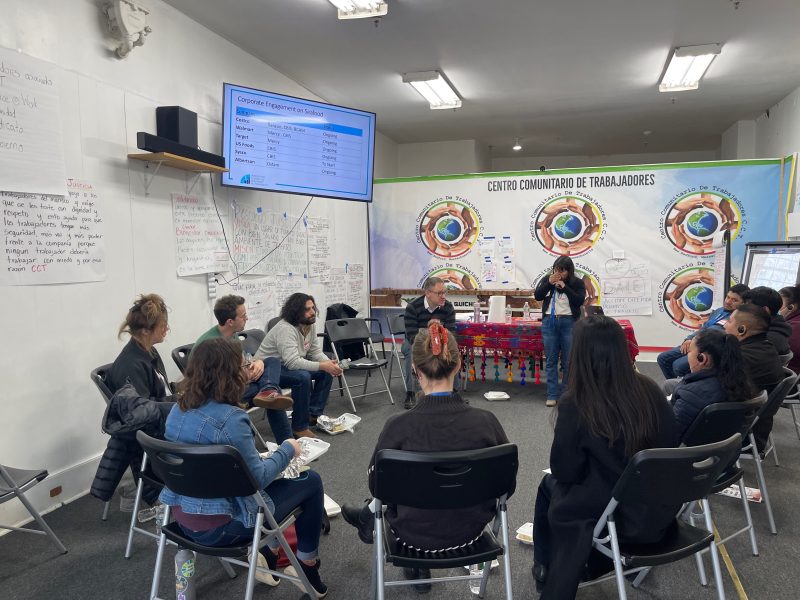
Investors are engaging major U.S. retailers and seafood buyers for engagement on labor rights risks in global seafood supply chains, including Costco, Walmart, Target, Sysco, US Foods, and Nomad Foods. Corporate dialogues focus on key investor asks related to transparency and the development of stronger grievance mechanisms and to support freedom of association and communication, supported by access to Wi-Fi on vessels. Investors continue to coordinate with NGO partners and worker representatives to shape engagement strategies and support corporate dialogues. The Director of the Equitable Global Supply Chain program participates in the Ethical Tuna Collaboration and is on the Advisory Committee for the Accountability Research Center’s research on recruitment practices in the seafood sector.
Sugarcane in Maharashtra
In 2024 and 2025, the New York Times and the Fuller Project provided extensive reporting on the disproportionately high rate of hysterectomies among women the sugarcane sector in India, as well as an ongoing concern with child labor. At the root of these abuses, among other structural issues, reliance in this sector and state on migrant labor and the exploitative practices of labor recruiters. Investors have engaged in dialogue with global sugar buyers, including Coca-Cola, PepsiCo, Mondelez, Unilever, General Mills, and Nestle. Two shareholder proposals were submitted. They have also had ongoing discussions with Bonsucro, a global sustainability platform for the sugarcane sector that sets standards for ethical and environmental production, to better understand changes to its auditing and certification practices on the ground. EGSC investors have partnered with local labor organizations like the Indian Sugar Industry Workers’ Association and MAKAAM to support the creation of a Fair Food Program, tailored to India’s sugarcane sector and building on lessons from worker-led models in agriculture.
Apparel
Building on the work of the Bangladesh Investor Initiative, investors continue to push companies to join the International Accord for Health and Safety in the Textile and Garment Industry, the Pakistan Accord on Health and Safety in the Textile and Garment Industry, and Employment Injury Scheme (EIS) for Ready-Made Garment (RMG) Workers in Bangladesh. The EIS Pilot was incorporated into national law in 2026. Investors also engaged Nike in recent years, encouraging the company to explore the use of WSR-aligned monitoring approaches, in part to avoid abuses that arose at Nike suppliers during the COVID period and that resulted in the non-payment of workers. In 2024, investor members filed a shareholder resolution No.6 in Nike’s 2024 Proxy Statement (see page 63) and developed arguments on the benefits of WSR-aligned models as a necessary supplement to auditing and monitoring in two exempt solicitations (Exempt Solicitation 1, Exempt Solicitation 2).
ICCR members started a collaborative engagement to support Know the Chain’s Apparel and Footwear benchmark in 2018. Investor members engage companies listed in the benchmark to encourage them to respond to KTC’s requests for information and to push these companies to improve their scores across reporting periods. Investors are currently previewing the 2027 Apparel and Footwear Benchmark, expected early next year.
Our Theory of Change
Legally-binding agreements between workers and companies that ensure suppliers respect workers’ rights have the ability to fundamentally reshape global supply chains.
The Business Case for Action
For decades, corporations have responded to the severe human and labor rights abuses endemic in their supply chains via an assortment of “corporate social responsibility” programs. These CSR programs are generally developed in a top-down fashion and executed in a manner that benefits companies rather than individuals. And so abuses have persisted, leaving millions working in egregious conditions for poverty wages. WSR offers a powerful and effective alternative by involving workers and their communities in the conceptualization and execution of remedial action.
Current Initiatives:
Through a combination of dialogue and the filing shareholder resolutions, ICCR’s members are pressing companies to implement WSR in their supply chains.

Our Impact
How ICCR is achieving meaningful gains for worker health and safety.

The number of brands and retailers that now support the International Accord for Health and Safety in the Textile Garment Industry.

The number of supplier factories that have committed to an improved culture of worker safety by signing the Pakistan Accord.