




Thermal energy networks present an opportunity for natural gas utilities to play a role in the transition to electric heating, though the industry faces hurdles as it seeks to harness the technology to decarbonize buildings.
We are pleased to provide you with Gibson Dunn’s ESG update covering the following key developments during July and August 2024. Please click on the links below for further details.
The Interfaith Center on Corporate Responsibility, whose members include religiously affiliated investors, said opposition by the CEO group the Business Roundtable to the SEC’s climate disclosure rule raised conflicts with the stated positions of many members. A Roundtable representative said it “regularly consults with our members.”
he Interfaith Center on Corporate Responsibility (ICCR) has criticised the stance of trade association the Business Roundtable (BRT) on the US Securities and Exchange Commission’s (SEC) Climate Disclosure Rule.
Support and against – Leaders of investor group Interfaith Center on Corporate Responsibility (ICCR) sent a letter to the board of CEO association Business Roundtable (BRT) on Thursday, concerning the BRT’s opposition to the SEC’s climate disclosure rules.
Six directors of the CEO lobby group run companies that publicly backed the SEC regulation that Business Roundtable is now fighting in court.
NEW YORK, NY, THURSDAY, AUGUST 22, 2024 – The Interfaith Center on Corporate Responsibility (ICCR) today announced it had sent a letter to board members of the Business Roundtable (BRT), a business trade association meant to advocate in the interests of its 200+ CEO members, calling out conflicts arising from an Amicus Brief it filed opposing the SEC’s Climate Disclosure Rule (the Rule).
ICCR is a coalition of over 300 institutional investors that engage their portfolio companies to mitigate adverse environmental and social impacts including the significant and material risks caused by the climate crisis.
The letter challenged the disconnect between the stated positions of many BRT members who acknowledge the market risks of climate change and the value of a to investors, and the actions of their trade association which run counter to those positions.
ICCR’s letter highlighted this misalignment and questioned the governance process surrounding the submission of the amicus brief asking whether BRT members were made aware the brief was being submitted and supported the action.
Said ICCR’s Board Chair, Rob Fohr, “The substance of the amicus brief filed by the BRT represents a position that does not appear to be completely aligned with the positions of many of its members. We wonder if the broader BRT membership was consulted for their input in advance of the vote. Since the BRT speaks with considerable authority for the business community it is important to understand the process behind this very public position.”
ICCR’s letter also challenged the BRT’s position that the SEC does not have the necessary authority to promulgate the Rule. In its Answering Brief, the SEC affirmed the length of the comment period, the fairness of the Rulemaking process, and its “well-established statutory authority to require the disclosure of information important to investors in making investment and voting decisions.”
An April 2024 study in the journal Nature led by Potsdam Institute climate economist Maximilian Kotz estimated that climate damage costs by 2050 will be six times larger than the cost of reducing carbon pollution consistent with targets under the Paris Climate Agreement over the same time frame. Investors see consistent and comparable corporate disclosure on climate risk, as outlined in the Rule, to be highly material and critical to investment decision-making. Investors representing tens of trillions of dollars in AUM supported the Rule via comment letters during its drafting and an Amicus Brief further articulating this support was filed by institutional investors last week.
According to ICCR’s letter: Many BRT members are active leaders in addressing the challenges of climate change and regularly disclose detailed reports on their policies and actions to reduce their greenhouse gas emissions consistent with the expectations of the Rule. In contrast, the BRT and the U.S. Chamber appear to have aligned their legal actions with some of the most forceful opponents of the Rule, namely oil and gas companies.
Said ICCR’s CEO Josh Zinner, “In our experience engaging companies on a range of environmental and social risks there is a corporate appetite for standardization in disclosure and reporting regimes that will level the playing field and take the guesswork out of the process: That is what the SEC’s Rule is meant to do. It is hard to reconcile our experience with the strident opposition of business trade associations like the BRT and the U.S. Chamber of Commerce who seem to be speaking only for a subset of its members seeking to thwart progress towards the clean energy transition we all know is inevitable. The appropriate way for the BRT to celebrate the 5th anniversary of its Statement of the Purpose of a Corporation would be to act on behalf of all its stakeholders by supporting climate-forward policy and regulation.”
ICCR said it has asked for a call with BRT Board members to discuss the issue.
CONTACT:
Susana McDermott
Director of Communications
Interfaith Center on Corporate Responsibility (ICCR)
201-417-9060 (mobile)
smcdermott@iccr.org
About the Interfaith Center on Corporate Responsibility (ICCR)
The Interfaith Center on Corporate Responsibility (ICCR) is a broad coalition of more than 300 institutional investors collectively representing over $4 trillion in invested capital. ICCR members, a cross-section of faith-based investors, asset managers, pension funds, foundations, and other long-term institutional investors, have over 50 years of experience engaging with companies on environmental, social, and governance (“ESG”) issues that are critical to long-term value creation. ICCR members engage hundreds of corporations annually in an effort to foster greater corporate accountability. Visit our website www.iccr.org and follow us on Twitter/X (@iccronline), LinkedIn, and Facebook.
ICCR Climate Crisis Issue Brief Two, August 2024
The decarbonization of the energy utility sector is a top priority for investors in the ICCR network. Investors are increasingly concerned about the expensive proposed “solution” put forward by major gas utilities to achieve “sustainability” of their networks, and should consider engaging companies on truly sustainable alternatives to the continued large investment in fossil gas infrastructure. The deployment of non-combusting thermal energy networks is a sensible path forward.
This ICCR brief discusses the aging infrastructure of the natural gas network and offers policy recommendations and guidance for shareholder engagement on thermal energy networks.
We are pleased to share this year’s edition of Catalyzing Corporate Change, our impact report on the outcomes of the 2024 proxy season.
In 2024, our members continued to press their portfolio companies for changes in policies and practices that would mitigate harmful environmental and social impacts. With nearly 400 shareholder proposals filed on a range of issues, we’re excited to share with you some highlights from the 2024 proxy season.
Below is a preview of what you’ll read in this year’s edition of Catalyzing Corporate Change:
2024 Resolutions By Issue
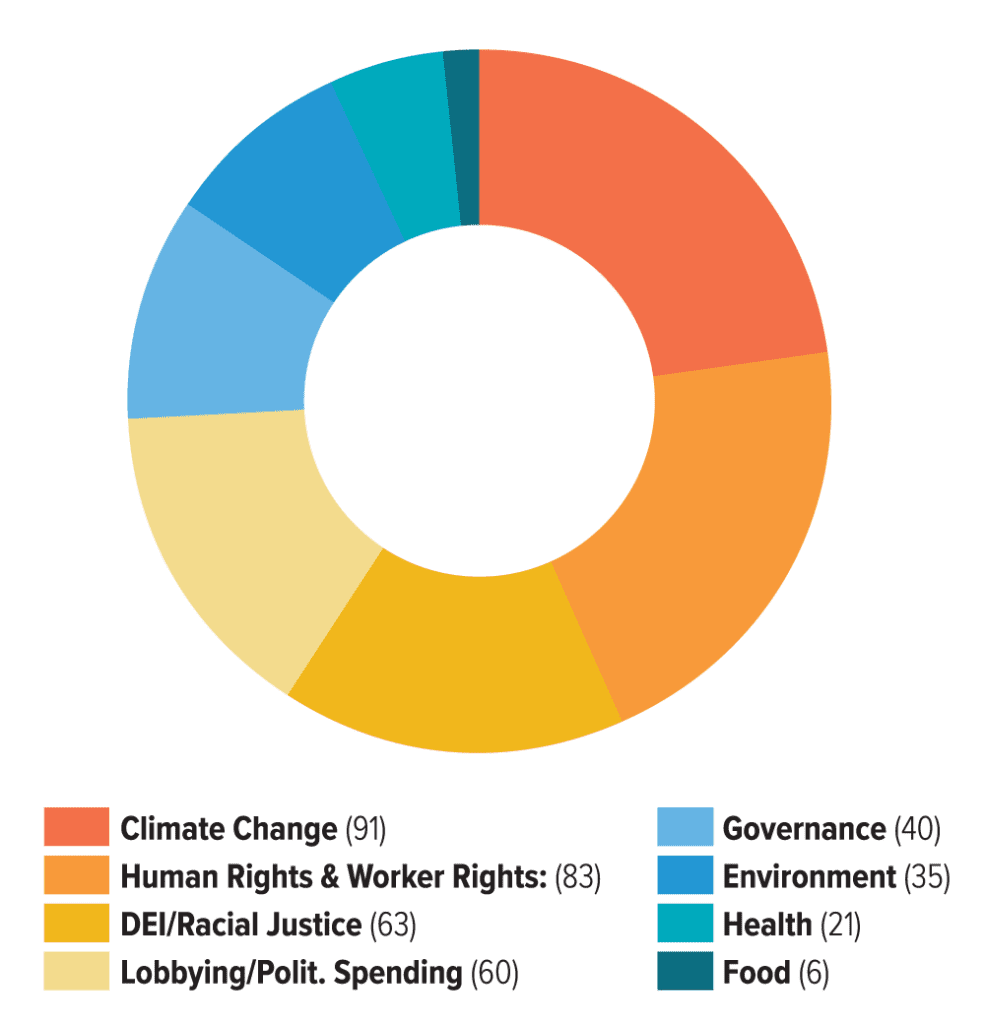
ICCR members secured 85 withdrawal agreements from companies in the 2024 proxy season.
2024 Corporate Commitments By Issue

Proposals receiving over 20% shareholder support are viewed by proxy advisor Glass Lewis as meriting a response from the Board. 109 shareholder proposals garnered over 20% shareholder support this proxy season.
Percent of Proposals Going to a Vote That Achieved Over 20% of the Vote
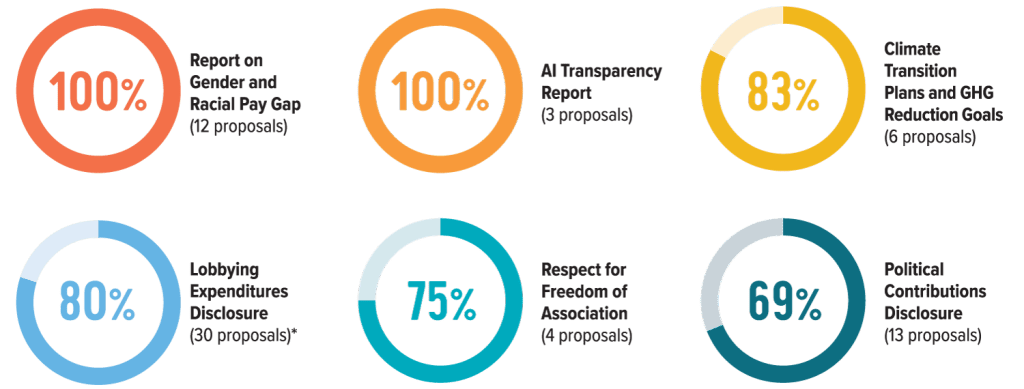
For a complete look at ICCR member successes during the 2024 proxy season, we invite you to download Catalyzing Corporate Change 2024 using the link below.
After firing 28 employees for protesting in favor of Palestine, Google’s CEO declared the company shouldn’t get distracted by politics because after all, “Google is a business.” This clear commitment to a company’s purpose has been praised, but it hides an uncomfortable reality—businesses are already deeply engaged in politics. So how does a company handle employees who want them to use their political influence for good?