



ICCR Issues Investor Guidance Report and Statement to Strengthen Executive Compensation Stewardship
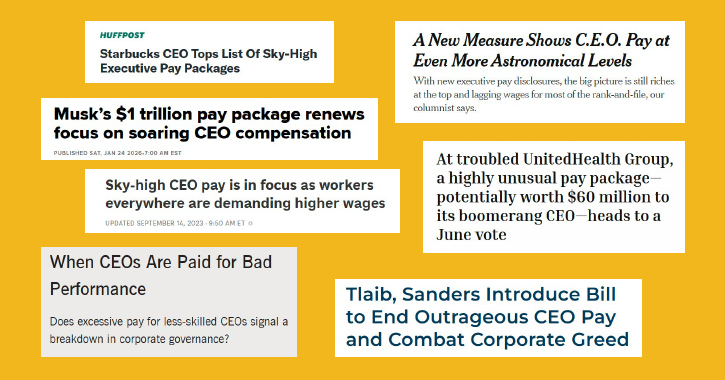
NEW YORK, NY — The Interfaith Center on Corporate Responsibility (ICCR) today released a comprehensive report and statement addressing the systemic economic risks posed by skyrocketing executive compensation and the investor imperative to rein in excessive pay through proxy voting and engagement. ICCR’s report Excessive Executive Compensation: Investor Guidance spotlights the ways that status quo executive compensation trends are distorting the wider economy.
The report’s release comes at a critical juncture –for decades, the gap between executive pay and median worker compensation has widened significantly; in 1965, CEOs were paid roughly 21 times as much as a typical worker, but by 2024, that ratio had surged to approximately 281-to-1.
In 2010 the Dodd-Frank Act introduced mandatory “Say-on-Pay” advisory votes to empower shareholders on this issue as part of its wider effort to shore up systemic risk in the financial system, resulting in the decline of some problematic practices. However, overall compensation levels have not declined. A growing number of investors are increasingly alarmed that this level of disparity is now entrenched and creates systemic risks that include eroded social cohesion, political polarization, and top-heavy, sluggish economic growth.
The report highlights several critical areas where current compensation practices and investor stewardship are falling short:
- Misalignment between Pay and Performance: Research suggests a weak or even negative correlation between the explosive growth of executive pay and actual shareholder performance. Numerous performance goals are criticized for being insufficiently challenging, lacking transparency, or being prone to self-serving manipulation by executives.
- High “Say-on-Pay” Approval Rates: Despite these growing concerns and performance issues, shareholder support for these management pay proposals averaged over 90%, largely driven by support from major asset managers.
- Need for Clearer Voting Thresholds: The report also showcases investors who have adopted quantitative cutoffs, such as voting against any pay package where the CEO-to-median-worker ratio exceeds 100-to-1, or where total executive compensation exceeds $10 million.
Accompanying the report is an Investor Statement on Excessive Executive Compensation, signed by a coalition of investors with more than $113 billion in AUM. The statement calls on investors to strengthen oversight, transparency and alignment in executive pay, including by reviewing their proxy voting records and guidelines on executive compensation, and engaging with companies and across the investment ecosystem to support improved practices. The signers commit to advancing stewardship practices that account for systemic and economic risk and promote workforce stability and support mechanisms that ensure all employees participate equitably in corporate success, including employee ownership and profit-sharing policies.
“This status quo of executive pay with entrenched practices set by powerful insiders must come to an end,” said Rosanna Landis Weaver, consultant to ICCR on executive compensation. “With economic inequality and the cost of living skyrocketing, these longstanding disparities have become too important to wish away. It is high time that shareholders better utilize the power they have to bring this challenge under control and finally tackle the gaping systemic risk created by a runaway executive compensation system that is only serving those at the very top of our economy.”
“For too long, investors have either looked the other way or rubber-stamped excessive executive pay packages,” said Matthew Illian, Director of Responsible Investing at United Church Funds. “Income inequality is a systemic risk and it is critical that investors take a hard look at how we are voting on this issue. There are many organizations in the ICCR community that have worked on this issue for decades, and this Investor Guidance offer both a historical perspective and forward-looking insights for responsible investors.”
“Excessive compensation for CEOs and other executives has been an alarming trend that calls for urgent policy solutions both from the public and corporate sectors,” said Hasina Razafimahefa, Senior Manager for Research and Evaluations at NEI Investments. “Inequality introduces systemic risks that affect all investors, but it’s crucial for investors to acknowledge that we are part of the system that created these risks. At NEI, we remain committed to collaborating with companies, regulators, and fellow investors to pursue evidence-based solutions that foster a more just and sustainable economy.”
“CEO pay that far outpaces the earnings of working people raises serious concerns for the long-term health of our economy and society,” said Gina Falada, Associate Director of the Advancing Worker Justice program at ICCR. “Investors are increasingly examining these disparities and their broader impacts. This report and related outreach are designed to support more thoughtful engagement on balanced and sustainable approaches to executive compensation.”
About the Interfaith Center on Corporate Responsibility (ICCR)
The Interfaith Center on Corporate Responsibility (ICCR) is a broad coalition of more than 300 institutional investors collectively representing over $4 trillion in invested capital. ICCR members, a cross-section of faith-based investors, asset managers, pension funds, foundations, and other long-term institutional investors, have over 50 years of experience engaging with companies on environmental, social, and governance (“ESG”) issues that are critical to long-term value creation. ICCR members engage hundreds of corporations annually in an effort to foster greater corporate accountability. Visit our website www.iccr.org and follow us on LinkedIn, and Bsky.