






Insight
We believe corporations have an obligation to advance health equity, and to assess how their business operations, services, and products may contribute to health inequities. For decades, ICCR members have engaged leading pharmaceutical companies on concerns related to access and affordability of medicines, vaccines, and other health technologies. Most recently, our focus has been on equitable access to COVID vaccines and therapies and how patent misuse may inhibit access to medicines
Our members also press food and beverage companies, casual restaurant chains, and retailers to increase their offerings of affordable nutritious foods to improve health outcomes worldwide. We also challenge technology companies to prevent and mitigate the algorithmic harms that occur through the use of AI in healthcare settings.
As faith-based and responsible investors, we advocate for corporate and systemic reforms that will improve the health and well-being of communities, especially communities that bear a disproportionate burden of disease evidenced by health inequities rooted in institutional racism. Corporations have an important role to play by ensuring that their business operations and public policy engagements do not contribute to or exacerbate existing racial or gender inequities, both in the US and globally.
Current Initiatives:
Through a combination of dialogue and the filing of shareholder proposals, ICCR’s members are seeking to improve community health.










Our Impact
How ICCR is driving systemic reforms that will improve access and affordability of health care for all.

Agreements at 11 opioid manufacturers and distributors negotiated by the IOPA to increase oversight and accountability structures to reduce the risk of opioid misuse.

Agreed to engage its suppliers on their use of pesticides harmful to human health and the environment

Agreed to enhanced disclosure of its legal settlements, moving towards greater alignment of executive compensation and accountability.
Health Equity Staff Contacts
To learn more about our program, reach out to our staff:

Meg provides strategic direction for ICCR’s engagements on health equity.
Phone:212-870-2984
Email:mjonesmonteiro@iccr.org

Misha provides cross-programmatic support for the Health Equity and Advancing Worker Justice programs.
Email:mahmad@iccr.org
Health Equity Resources
Publications, blogs, investor statements, comment letters, webinar recordings and press releases related to investor action on health equity.
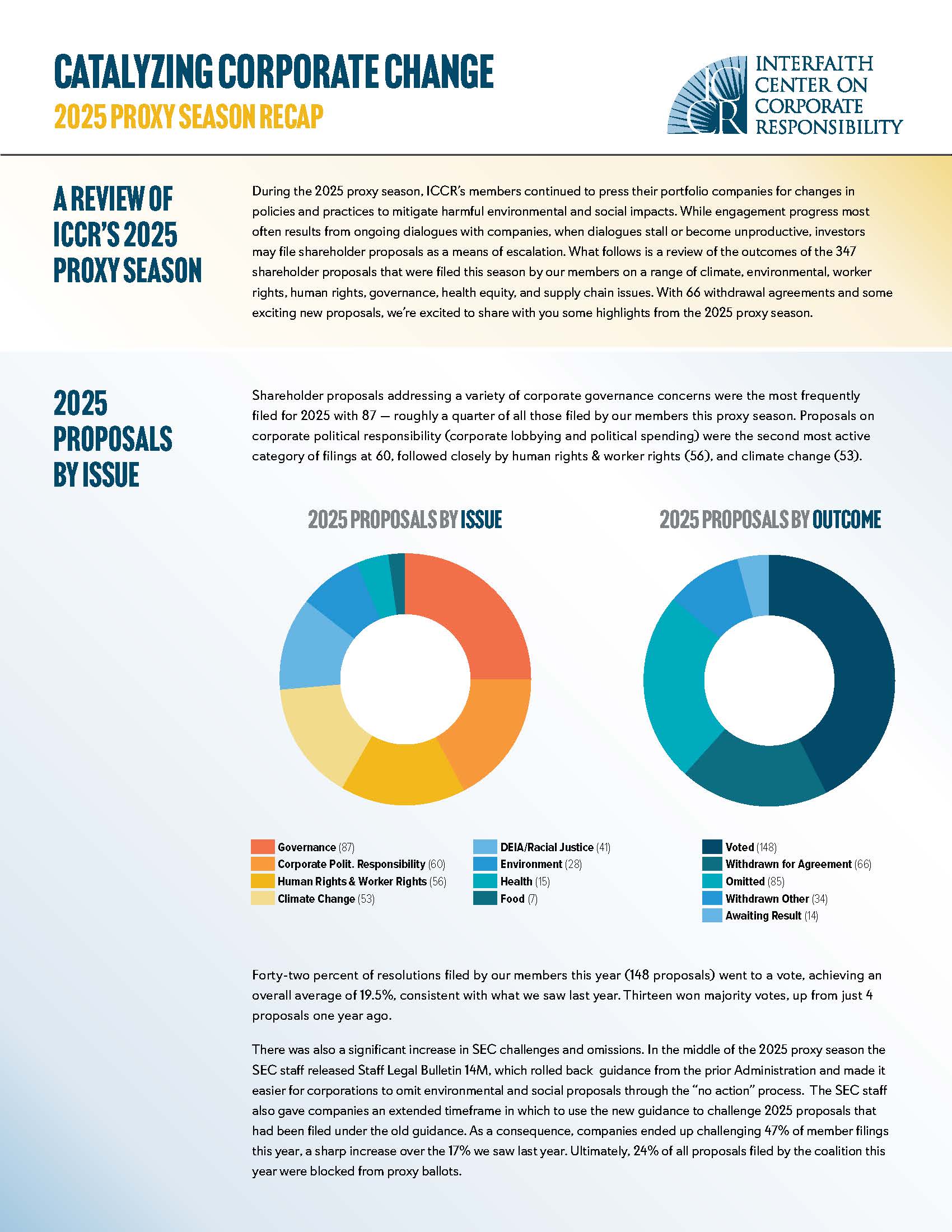
During the 2025 proxy season, ICCR’s members continued to press their portfolio companies for changes in policies and practices to mitigate harmful environmental and social impacts. While engagement progress most often results from ongoing dialogues with companies, when dialogues stall or become unproductive, investors may file shareholder proposals as a means of escalation. What follows […]
While there are many concerning provisions in the “One Big Beautiful Bill Act” (OBBBA), one stands out for us: the provision imposing a 10-year moratorium on state and local regulations of artificial intelligence (AI). This measure, embedded within the broader budget reconciliation package, aims to centralize AI oversight at the federal level, effectively overriding existing […]
April 17, 2025. The undersigned investors affirm affordable and equitable healthcare as a human right and recognize a robust public health system as essential to the well-being of our citizens, our workforce, and a thriving economy.
Published March, 2025. The upcoming 2026 edition will be released in late March, 2026. ICCR has been publishing the Proxy Resolutions and Voting Guide annually since 1974 as a way to educate and build support for member proposals. In it, you will find all ICCR member-sponsored proposals for 2025 corporate proxies along with a preliminary overview […]
RESOLVED, that shareholders of Eli Lilly and Company (“Lilly”) urge the board of directors to oversee conduct of human rights due diligence (“HRDD”) to produce a human rights impact assessment (“HRIA”) covering Lilly’s operations, activities, business relationships, and products, including access to medicines. The HRIA should be prepared at reasonable cost and omitting confidential and […]
RESOLVED, that shareholders of Gilead Sciences Inc. (“Gilead” or the “Company”) urge the board of directors to adopt a comprehensive human rights policy covering Gilead’s operations, activities, business relationships, and products, that commits Gilead to respecting internationally recognized human rights, including the right to health, and to conducting human rights due diligence (“HRDD”) to identify, […]
RESOLVED, that shareholders of AbbVie Inc.(“AbbVie”) urge the board of directors to oversee conduct of human rights due diligence (“HRDD”) to produce a human rights impact assessment (“HRIA”) covering AbbVie’s operations, activities, business relationships, and products, including access to medicines. The HRIA should be prepared at reasonable cost and omitting confidential and proprietary information and […]

A key product in the effort to end TB is diagnostic testing. More than 1 in 3 people with TB go undiagnosed, and part of the reason why is lack of access to and affordability of testing. Last September, Cepheid, a molecular diagnostic company and subsidiary of Danaher Corporation, announced a 20% price reduction of its Xpert test […]
We write as members of the Interfaith Center on Corporate Responsibility (ICCR), a coalition of faith and values-based investors, in response to the request for comments by HHS on the implications of access and benefit sharing (ABS) commitments/regimes and other proposed commitments being considered under a WHO Convention, Agreement or Other International Instrument on Pandemic […]

ICCR’s guiding principle is that sustainable corporations must look beyond the next earnings report to account for the full impact of their businesses on society and the environment, and must view the well-being of all of their stakeholders ― including their workers and the communities where they operate ― as integral to their long-term success. […]
IOPA was established in 2017 to engage with opioid manufacturers, distributors, and retail pharmacies on opioid-related business risks that have implications for long-term shareholders, communities, and the economy. In 2023, the IOPA wound down its collaborative efforts. In its five years of operations, the coalition actively engaged numerous corporate boards and executives in dialogue, filed […]
Partnership for a Healthier America has launched its Food Equity Opportunity Map in partnership with the University of Maryland Baltimore County, highlighting where improving access to good food would make the greatest impact and allowing everyone to see what Food Equity looks like in their community for the first time.