





Insight
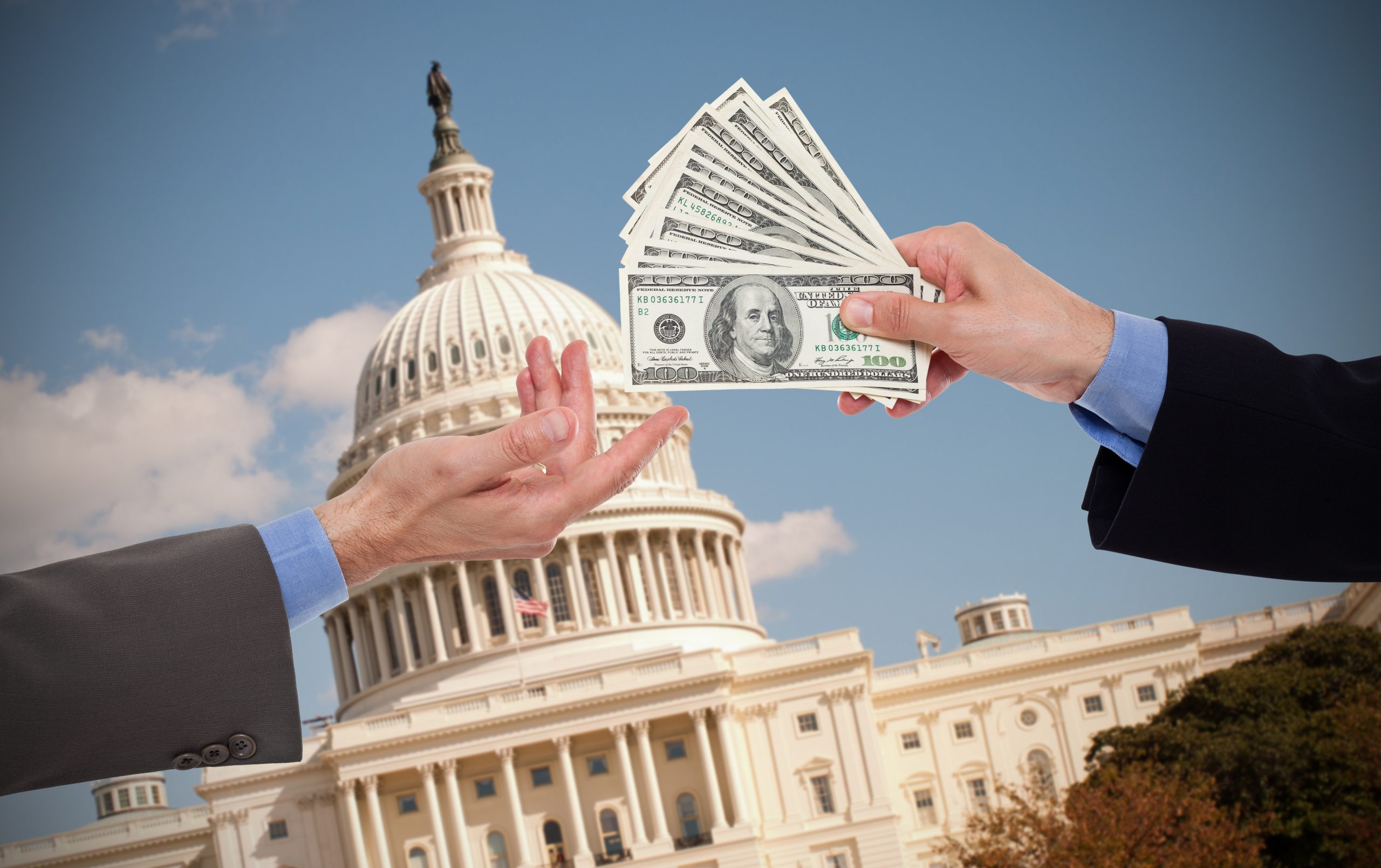
Corporations spend millions of dollars each year to influence U.S. legislative and regulatory systems to the benefit of their businesses. Absent adequate oversight, corporate political donations to legislators and lobbying activities may exert an outsized influence over our democratic institutions to the disadvantage of voters. Through their memberships in trade associations like the U.S. Chamber of Commerce and the National Association of Manufacturers, and their donations to Super PACs, 527 committees, “social welfare” organizations, and model legislation group the American Legislative Exchange Council (ALEC), corporations have an outsized voice on many issues impacting the public interest. Without adequate oversight, these political activities run the risk of disenfranchising voters, damaging democratic structures and, when these activities conflict with a company’s stated mission and values, causing reputational damage to participating companies.
To avoid these risks, ICCR members argue for full transparency, robust oversight structures, and policies to govern corporate political activities.
Current Initiatives:
Through a combination of dialogue and the filing shareholder resolutions, ICCR’s members are pressing these companies to do their due diligence with regards to their political spending, and enhance their public disclosures.






Our Impact
How ICCR is pressing companies to disclose their “dark money” spending to influence U.S. and global legislative and political systems.

Shareholder proposals withdrawn for corporate commitments in 2023: AT&T, Charles River Laboratories, Disney, EOG Resources, MasterCard, ServiceNow, and UPS.

Average vote for all political spending and lobbying proposals that went to a vote in the 2023 proxy season.

The percent of 2023 political spending and lobbying proposals that went to a vote winning votes of 25% or greater.
Corporate Political Responsibility Staff Contacts
To learn more about our program, reach out to our staff:

Tim supports ICCR’s work around responsible political engagement.
Phone:212-870-2295
Email:tsmith@iccr.org
Corporate Political Responsibility Resources
Publications, blogs, investor statements, comment letters, webinar recordings and press releases related to investor action on corporate political responsibility.
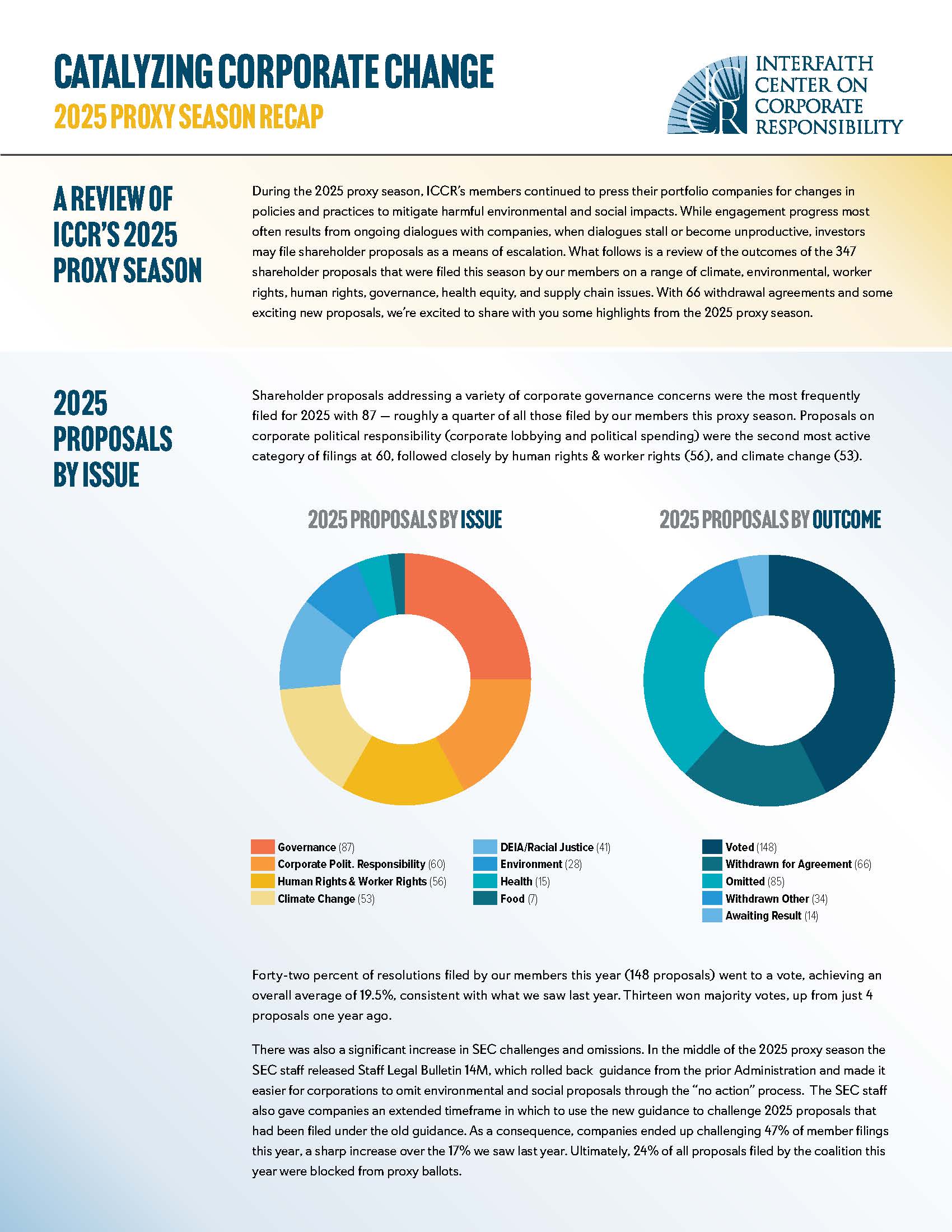
During the 2025 proxy season, ICCR’s members continued to press their portfolio companies for changes in policies and practices to mitigate harmful environmental and social impacts. While engagement progress most often results from ongoing dialogues with companies, when dialogues stall or become unproductive, investors may file shareholder proposals as a means of escalation. What follows […]
ICCR has been publishing the Proxy Resolutions and Voting Guide annually since 1974 as a way to educate and build support for member proposals. In it, you will find all ICCR member-sponsored proposals for 2025 corporate proxies along with a preliminary overview of the proxy season and short features from proponents about their engagements on key […]
This presentation explains the foundational elements of climate lobbying, from investor expectations and enterprise risk, to examples of leading corporate practices.
To help public companies navigate the challenges and risks of spending to influence elections in a turbulent political era, CPA issued this practical checklist
On August 10, 2023, members of the Interfaith Center on Corporate Responsibility (ICCR) announced they had sent letters to members of the Business Roundtable urging them to align political spending with their stated core values, to mitigate both reputational risks to the company, and broader risks to democracy.

The need to reduce GHG emissions to limit warming and reach net zero by 2050 or sooner has never been more urgent yet climate progress has been hindered for decades by aggressive lobbying on the part of corporations (mainly in the oil & gas sector) and their trade associations. Because investors understand that corporate climate […]
This CERES report examines the climate-related risk management, governance and lobbying practices of S&P 100 companies. It finds that the nation’s largest publicly traded companies are increasingly lobbying for policies that will help the U.S. achieve its commitments under the Paris Agreement. However, very few are publicly reckoning with the role of their own trade associations […]
The Principles were created by the Corporate Political Responsibility Taskforce at the Erb institute at the University of Michigan, in a multi-stakeholder process involving corporate executives, business networks and stakeholders from across the political spectrum. They offer an actionable, non-partisan template to help companies determine whether and how to engage in civic and political affairs […]
Report from the Center for Political Accountability showing that 75 leading public companies undercut their climate change commitments through conflicted Political spending
On July 28, 2022, a group of investors representing U.S. $131B in assets under management announced they sent a letter to the Directors of the U.S. Chamber of Commerce (U.S. Chamber) calling on them to advocate for the public policies needed to bring greenhouse gas emissions (GHG) emissions in line with Paris goals.
A report from the Center for Political Accountability. The political spending of companies too often does not fall in line with their public commitments. There are companies giving millions of dollars to a partisan political group closely tied to robocalls one day before Jan. 6, 2021
ICCR letter encouraging FERC to promote utility sector lobbying transparency. ICCR’s comments were submitted to the Federal Energy Regulatory Commission (FERC) on the Commission’s “Notice of Inquiry on Rate Recovery For Industry Associations And Utilities Engaged in Anti-Climate Advocacy Activities” (DOCKET RM22-5). Submitted in February of 2022 in response to FERC Questions 6, 7, and 9.