






Insight
ICCR’s Advancing Worker Justice (AWJ) program brings shareholder advocates and allied worker-led and focused organizations together to advance dignity and justice for all working people. We seek to activate our investments, strategic partnerships, and movement-building strategies to influence workplace practices, build worker power, and achieve meaningful gains for workers’ rights in the U.S. and Canada. We approach this work for justice with an intersectional lens, centering the voices and experiences of frontline and essential workers, working people of color, workers with disabilities, migrant workers, women, and LGBTQIA+ workers.
Current Initiatives:
Through a combination of dialogue and the filing shareholder resolutions, ICCR’s members are pressing companies to advance dignity and justice for all working people.















Our Impact
How ICCR is achieving meaningful gains for workers’ rights in the U.S. and Canada.

Percent of shareholders voted in support of a Freedom of Association proposal at Starbucks

The amount of paid sick leave given to Norfolk Southern union workers, a first for major North American freight railroads

Percent of shareholders who voted in support of requesting an independent audit on worker health and safety at Dollar General
Advancing Worker Justice Staff Contacts
To learn more about our program, reach out to our staff:

Nadira Narine is primarily responsible for research and analysis, coordination and support of ICCR’s Advancing Worker Justice program area
Phone:212-870-2275
Email:nnarine@iccr.org

Gina is responsible for building investor capacity to engage companies around key issues impacting frontline workers in the U.S. and Canada.
Phone:212-870-2274
Email:gfalada@iccr.org
Advancing Worker Justice Resources
Publications, blogs, investor statements, comment letters, webinar recordings and press releases related to investor action on advancing worker justice.
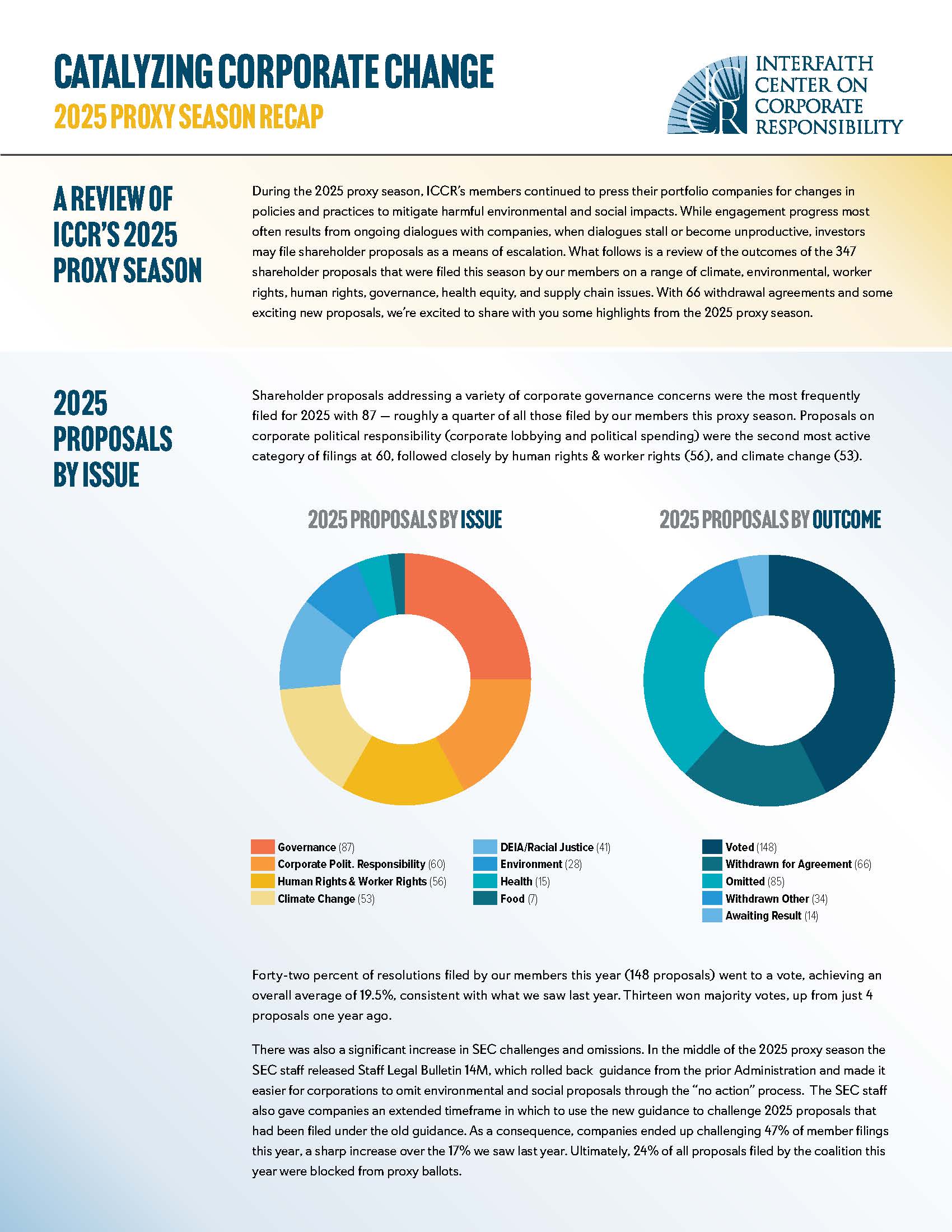
During the 2025 proxy season, ICCR’s members continued to press their portfolio companies for changes in policies and practices to mitigate harmful environmental and social impacts. While engagement progress most often results from ongoing dialogues with companies, when dialogues stall or become unproductive, investors may file shareholder proposals as a means of escalation. What follows […]
Published March, 2025. The upcoming 2026 edition will be released in late March, 2026. ICCR has been publishing the Proxy Resolutions and Voting Guide annually since 1974 as a way to educate and build support for member proposals. In it, you will find all ICCR member-sponsored proposals for 2025 corporate proxies along with a preliminary overview […]
We call on Congress to reject piecemeal immigration-related orders and directives that only prolong uncertainty and create confusion and instead come together to enact comprehensive immigration reform that protects all stakeholders and fosters long-term economic growth. We urge the business and investment communities to join this effort, as the uncertainty created by disruptive and discriminatory […]
Many Corporate leaders continue to defend diversity programs as they come under attack from conservative critics. For diversity, equity, and inclusion (DEI) programs, visible public support is more important than ever. Some companies like John Deere and Tractor Supply are cutting back or severely limiting their diversity programs. And many others are lowering their programs’ […]
This report focuses on the increasingly pervasive role that digital technologies play in the workplace and how those technologies may harm workers, especially low-wage workers. It builds on the current work of the Advancing Worker Justice program at the Interfaith Center on Corporate Responsibility, which seeks to bring shareholder advocates and allied worker-led and focused […]

ICCR’s guiding principle is that sustainable corporations must look beyond the next earnings report to account for the full impact of their businesses on society and the environment, and must view the well-being of all of their stakeholders ― including their workers and the communities where they operate ― as integral to their long-term success. […]
On November 15, 2023, the undersigned investors, representing $4.5 trillion in assets under management and advisement, call on U.S. companies to take steps towards the payment of a living wage to direct and contract workers, in line with international human rights standards. Long-term investments in the workforce are good for business, helping companies attract and […]
Analysis from the U.S. Department of Treasury